Director General's comment: keeping repair on the table
As I write, the conflict in the Middle East has flared again. On 13 July, United States and Iranian forces traded strikes around the Strait of Hormuz, sending Brent crude up 4.3% to around $79 a barrel. The disruption I wrote about last quarter has not gone away – it has simply moved to a lower simmer, ready to boil over again with little warning.

The raw materials picture has, if anything, worsened. Every one of the 18 rare earth elements tracked by industry analysts rose in price through July, the broadest gain of the year. Dysprosium is now up 105% since January and neodymium up 64%. These are the elements behind the permanent magnets in many modern motors, and the increases feed straight through to replacement cost. Copper has eased slightly from June’s highs but is still trading above $13,000 a tonne on the London Metal Exchange.
Closer to home, Make UK and Ecotricity published a report this month warning that high industrial electricity prices could cost the United Kingdom (UK) economy £85 billion if left unaddressed. 90% of manufacturers say their energy bills have risen at least moderately since 2022, and British industry now pays £86 per megawatt hour against £69 in France and £60 in Germany. 63% of manufacturers have already taken steps towards electrification, but the price gap between gas and electricity is holding many of them back from investing further.
None of this changes the basic order of operations for anyone running this kind of equipment. Buy durable, efficient machines. Maintain and monitor them properly. Repair them when they fail. Recycle the materials only once repair genuinely isn’t possible. What has changed is how often that sequence gets skipped. Replacement has become the default reflex, not because it usually is the better answer, but because repair rarely gets asked the question. When a machine goes down, the test should be simple: which option, repair or replace, costs less energy and less money over what’s left of that asset’s working life? Right now, that comparison isn’t being made often enough.
That is part of what is driving the regulatory push behind Right to Repair. The European Union’s Right to Repair Directive must be transposed into the national law of member states by 30 July, and England’s long-delayed Circular Economy Growth Plan is expected before Parliament rises for the summer recess on 17 July, after several rounds of slippage since it was first promised last autumn. Neither guarantees repair wins that comparison. They simply stop manufacturers removing repair as an option before the comparison can be made.
Members brought me a case this quarter that shows what happens when repair isn’t given that chance at all. A hospital’s air handling unit failed. The repair – parts and labour – would have cost around £200. But the manufacturer’s proprietary software locked the unit’s controls, and the only sanctioned fix was a full replacement at £20,000. That is not a story about one hospital’s bad luck. It is what happens whenever a manufacturer makes repair difficult rather than support the people who do it well.
Done properly, repair isn’t a compromise either. A joint AEMT and EASA study from 2019 found that motors rewound to the correct standard can achieve IE3 (International Efficiency class 3) performance – as good as new, and sometimes better once modern winding materials are used. Research by Houghton International, now known as IPS Newcastle, puts the carbon saving from repairing a motor rather than replacing it at around 40%. Figures like these only matter if repair is actually weighed against replacement rather than passed over by habit.
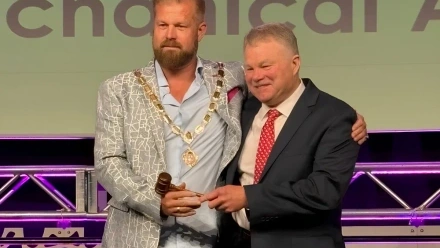
At our Annual General Meeting (AGM) on 25 June – our 81st – I reported that 42 service facilities are now engaged with the AEMT Codes of Practice and Verification Scheme, with around six in ten already compliant or verified. We paused the scheme briefly to simplify the self-assessment process, and it relaunches this month with a target of 90% completion by the year end. We also launched a free Emissions Tracker, built with Climate Action for Associations, so members can measure their Scope 1, 2 and 3 emissions without buying expensive software. If your service provider carries the AEMT mark, you can trust the quality of the repair you’re being offered as a genuine alternative to replacement.
We are also putting members’ expertise into EEMUA (Engineering Equipment and Materials Users’ Association) 230, the guidance that asset owners rely on for maintaining ageing rotating equipment. It is getting its first major update since 2015, and the current draft is thin on motors and generators. A panel of our members is working to put that right.
Save the date for the AEMT Conference on 24 September and our annual awards on 19 November. This year’s conference theme is work together, collaborate and strengthen the industry, and our keynote speaker is Chris Boardman CBE. Meanwhile, for its 2026 staging we have added two new categories to our awards programme: Small Service Centre of the Year and Electromechanical Champion of the Year. Both of these cornerstone events for the AEMT promise to be excellent opportunities to network, learn and celebrate our sector’s important work, and I hope to see many of you there.
Energy is expensive, materials are dearer still, and the rules are shifting under our feet. None of that is an argument for repairing everything, or for never replacing anything. It is an argument for putting repair back in front of asset owners as a genuine, honestly costed option whenever a machine fails. That is the work our members do, and it matters more with every passing quarter.
------------------
This article appeared in Renew magazine. To read more or request your personal digital or print edition of Renew, click here.