
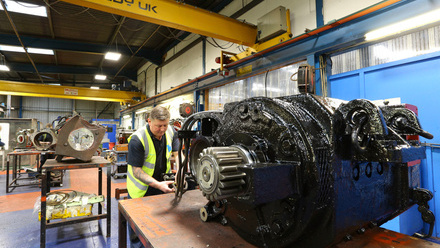
UK rules already require manufacturers to keep spare parts and repair information available for washing machines, fridges and televisions. Industrial motors, generators, pumps and gearboxes have no equivalent, even though they run the country's factories, water works and hospitals.


AEMT is asking the UK Government to extend repairability requirements to this equipment. To make the case, we need real examples from the people who repair and run it.
On this page: Why it matters | What we are asking for | Tell us about your case | Who can contribute | How we use what you tell us
Why it matters
Keeping installed equipment running efficiently, rather than replacing it by default, saves carbon and takes pressure off supply chains that are already stretched.

43 to 46%
The estimated share of the world's electricity used by electric motor-driven systems.

40.9%
Lower global warming potential when a motor is repaired after ten years rather than replaced.

37.4%
The same comparison for generators. Both figures come from a Newcastle University study carried out with an AEMT member.

0.2%
The most that efficiency changed after a good-practice rewind, in research by AEMT and the Electrical Apparatus Service Association (EASA).
What we are asking for
We want the Government to use the Product Regulation and Metrology Act 2025 to extend four requirements to industrial rotating equipment. We are making the same case in Europe under the Ecodesign for Sustainable Products Regulation.
Cars already work this way
Drivers can take a car to any competent garage, not just the manufacturer's dealer, because vehicle makers must share repair information with independent workshops. We are asking for the same principle to apply to industrial equipment.
This is not an argument against replacement. New equipment is often the right answer. We want that decision made on objective evidence, with repair as a real option.
Tell us about a repair that was not possible
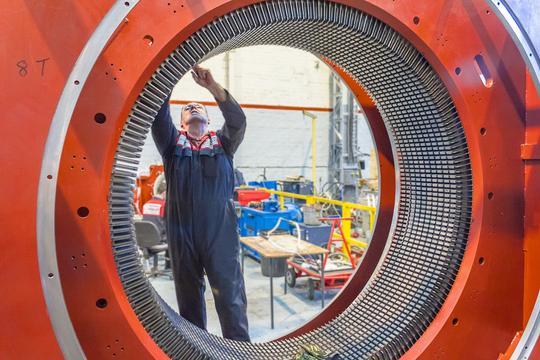
Government listens to specific cases far more readily than to general claims. If you have repaired, or tried to repair, industrial equipment and could not, we want to hear about it. We are looking for three kinds of case:
- Equipment that was scrapped because repair was not possible.
- Repairs that were only possible after long delays or great difficulty.
- Repairs that were possible but uneconomic because of the cost or availability of parts or information.
Tell us what the equipment was, what stopped the repair (parts, documentation, diagnostic access or design) and what happened as a result. Rough costs, delays and the weight of anything scrapped are especially useful.
Get in touch with the AEMT team in the usual way. A few lines is enough to start, and we will follow up with some questions. Not a member? Use our contact page.
Who can contribute

Members and their customers
AEMT members, and the plant and maintenance engineers they work for. If you have been told that something cannot be repaired, we want to hear from you. Many members now also offer reliability services such as condition monitoring. If that work has shown you equipment that could not be repaired when it needed to be, that counts too.

Manufacturers
We want the full picture, including where replacement was the right call and where limits on repair were justified. Tell us about cases where replacement was the better decision, your concerns about safety, security or liability, and what you already do to support independent repairers. Views are collected through an independent party and anonymised unless you agree otherwise.
How we use what you tell us
Cases are anonymised by default. We will not name you or your company without your written agreement.
We share cases only with the Government and the researchers working with us, never with other members. Where cases involve competing firms, we handle them so that no commercially sensitive information passes between companies.