
The vital trade keeping equipment turning
The winding industry has long been the unsung hero behind the seamless operation of countless businesses across the country. From manufacturing plants to water treatment facilities, the ability to repair and restore electric motors and rotating equipment is essential to maintaining uptime and avoiding costly replacements.
Over the years, the sector has evolved from manual craftsmanship to incorporate automated and intelligent technologies, but its core purpose of keeping organisations moving remains unchanged.
Yet, a growing shortage of skilled technicians threatens to extend the lead time for repairs of critical equipment. This challenge risks sending a customer down the route of replacement, which isn’t always economically viable or the quickest way to get operations up and running again, resulting in further downtime. In some cases, replacements simply aren’t available, especially for older or bespoke equipment, making rewinding the only viable option.
Before diving into the benefits of working in the sector, what actually is winding?
THE IMPORTANCE OF WINDING
Winding involves far more than fixing broken motors. It is about ensuring compliance, efficiency and adaptability. Businesses may require winding services for a variety of reasons, including adaptation to new applications, improving energy efficiency and as mentioned, repairing motors that have suffered damage and wear.
Motors may require rewinding to accommodate changes in voltage, especially when equipment is repurposed or relocated overseas. A properly rewound motor can operate at near, if not at, its original efficiency, extending its life and saving decision-makers from shelling out on costly and unnecessary upgrades.
The most common reason for rewinding, however, is a lack of maintenance, which subsequently leads to motor failure. From rising operational costs to a growing shortage of skilled labour (notice a trend?), there are several reasons why equipment maintenance ends up being delayed or completely avoided. When this happens, the likelihood of equipment failure soars.
SPECIALIST SKILLS
As experienced workers retire, there are simply not enough new entrants to fill the gap. This is partly due to a lack of awareness, as many young people just do not know this career path exists.
On top of this, winding requires niche skills that aren’t typically learnt at school or college. Beyond patience and a good level of mathematical knowledge, the role of a winding technician demands precision and attention to detail. The learning curve is steep, especially when dealing with complex motors, and a single coil or incorrect insulation could skew measurements. Perhaps most importantly, a technician must enjoy problem solving. Diagnosing faults is not always straightforward and often requires intuition to identify the root cause.
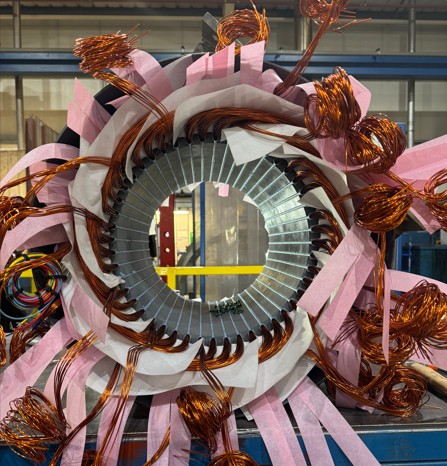
To combat the skills shortage, more businesses are offering apprenticeships to young professionals. As it can take up to five years to learn the necessary skills, these require a significant investment in terms of both time and money. Doing so, however, provides apprentices with the opportunity to hone their craft through hands-on experience, with tasks including:
• Disassembling motors to identify the problem
• Cleaning and prepping the stator or rotor for rewinding
• Carefully rewinding the motor by hand
• Insulating and varnishing to protect windings
• Operating sophisticated testing equipment to check performance before the motor is returned to service
ENDLESS EQUIPMENT POSSIBILITIES
Winding technicians have the chance to work on different equipment each day. Examples at Arfon include an emergency motor rewind as part of a complete repair of a local hospital’s main boiler pumps. This feeds the heating throughout the hospital, vital for the comfort of inpatients and outpatients, and critical to keeping wards and operating theatres running.
Demonstrating the variety of equipment that enters the workshop, Arfon also completed an out-of-hours rewind on a lift motor for an assisted-living complex in the local community. This motor operates the lift in a building for residents with limited mobility, who rely on this for access.
More recently, the team worked with a local water authority to rewind a large stator for a submersible sewage pump on emergency service. This pump prevents sewage overflow into the waterways, which could lead to serious pollution incidents and, from a business perspective, significant fines from the water regulator Ofwat.
SOUGHT-AFTER TALENT
Over the years, Arfon has built a robust apprenticeship designed to attract, train and retain new talent. In the last decade, every apprentice taken on has stayed with the firm, growing into confident and capable technicians, myself included.
As motors become smaller and more specialised, the demand for skilled winding technicians will only increase. Automation can help, but it can’t replace the intricate understanding required for a range of jobs. Whether it’s due to legacy equipment becoming irreplaceable or systems being redesigned, some things can only be done by hand.
There is a place in the winding industry for any individual who is curious, committed and willing to learn. With the right support, they can build a career that is both rewarding and essential to the day-to-day operations of companies across the country.
------------------
This article appeared in Renew magazine. To read more or request your personal digital or print edition of Renew, click here.